Pros
- Strong gaming-focused hardware for the money in this class
- Sharp and smooth 16-inch 165Hz 16:10 display
- 1TB SSD and 16GB DDR5 make it usable right away
- Upgrade-friendly design and configurable RGB with Stealth Mode.
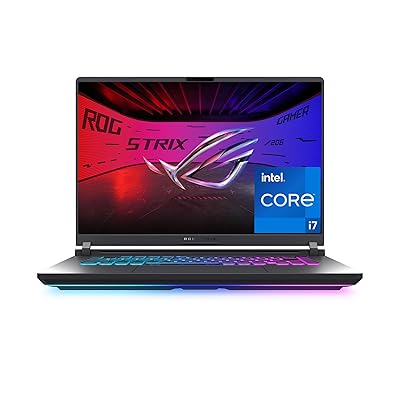
The ASUS ROG Strix G16 (2025) is for the shopper who wants a real gaming laptop rather than a thin everyday machine with decorative RGB. Its strongest case is clear: a 16-inch 165Hz display, Core i7-14650HX, RTX 5060 Laptop GPU, 16GB DDR5, and 1TB Gen 4 SSD make it a serious desktop-replacement route for modern games and heavier multitasking. The trade-off is just as clear: this is not the laptop to buy for long unplugged days or cool-on-your-lap comfort.
I’d steer this model toward players who mostly game near an outlet, want a fast high-refresh panel, and care about easy storage or memory upgrades later. I’d skip it if your priority is all-day campus use, quiet battery-first travel, or a trouble-free machine for fullscreen brightness tweaking and similar edge-case quirks. Its appeal comes from performance and screen quality, not from mobility.
| Screen size | 16 inches |
|---|---|
| Resolution | 1920 x 1200 |
| RAM | 16 GB DDR5-5600MHz |
| Storage | 1 TB PCIe Gen 4 SSD |
| Refresh rate | 165Hz |
The 16-inch 1920 x 1200 screen gives this laptop a better shape for mixed use than an older 16:9 gaming panel. You get more vertical room for documents, web pages, and side panels while keeping a familiar FHD-class load for the GPU.
The 165Hz refresh rate and 3ms claim matter most if you actually play fast games. Even outside shooters, the smoother panel makes the whole machine feel quicker during everyday navigation.
This configuration pairs an Intel Core i7-14650HX with an RTX 5060 Laptop GPU, 16GB DDR5, and a 1TB Gen 4 SSD. That is the right kind of parts mix for someone buying a gaming laptop to use as a primary machine rather than a secondary toy.
The practical upside is that it starts strong and still leaves room to grow. Owners specifically call out easy access for storage and memory upgrades, which is valuable because 16GB is fine now but not the ceiling many power users will want long term.
ASUS leans hard into cooling here with vapor chamber, tri-fan design, and liquid metal, and that matters because gaming laptops live or die by sustained comfort, not just headline parts. The better outcome is stable play without the machine sounding constantly strained.
The 360-degree RGB light bar could have been pure decoration, but the inclusion of Stealth Mode gives it a practical second life. You can enjoy the full ROG look at home, then shut it down for a cleaner office or classroom setup.
Sit this on a desk, plug it in, and the G16 immediately makes sense as a gaming-first machine. The 16-inch 1920 x 1200 panel gives you a taller 16:10 workspace than a standard 1080p gaming laptop, and at roughly 141 pixels per inch it lands in a comfortable zone for games, browsing, and general desktop work without looking coarse at normal distance. The 165Hz refresh rate is the part you notice fastest in motion: cursor movement, menus, and supported games all feel cleaner and more responsive than on a basic 60Hz panel. The catch is that this visual smoothness belongs to a plugged-in setup more than a coffee-shop routine.
Move from web browsing into game installs, launcher updates, Discord, and a few browser tabs, and the hardware balance feels appropriate for the class. The Core i7-14650HX, RTX 5060 Laptop GPU, 16GB of DDR5, and 1TB SSD give this configuration enough headroom for modern gaming and everyday multitasking without making storage feel cramped on day one. There is a practical tension here, though: 16GB is a sensible starting point for current games, but it is also the first spec ambitious owners may want to expand if they keep many heavy apps open or plan to lean harder into VMs, modded games, or creation work.
For longer sessions, cooling and comfort are where the buying decision gets more specific. The thermal design is ambitious, with vapor chamber, tri-fan cooling, and liquid metal, and the upside is that many owners describe strong performance without intrusive fan noise. But this is still a performance laptop, and warmth at the bottom center or palm area can become part of the experience in demanding play. If your habit is gaming at a desk, maybe with a cooling pad, that trade-off is easy to live with. If you want to use it directly on your lap for extended sessions, it becomes a much less convincing fit.
As a day-to-day machine outside gaming, the G16 is good enough rather than universally polished. Wi-Fi 7 and a fast SSD help it feel quick at startup, downloads, and general responsiveness, and the chassis gets praise for looking sleek rather than overly chunky. The full-surround RGB light bar is fun when you want the gaming look, and Stealth Mode matters more than it sounds because it lets the laptop blend into work or school spaces. The weak point in this everyday route is battery life: this machine repeatedly lands in the short-session lane away from the charger, so room-to-room use is fine, but a long mobile workday is not its strength.
Community
The recurring pattern is easy to read: people love the screen, speed, and gaming value, while the main complaints center on battery life, occasional heat buildup, and a few software or key-function annoyances that show up around updates or fullscreen behavior.
I updated the BIOS and drivers right away and the laptop has been great so far. The screen looks clear and bright, my demanding Steam games run flawlessly, and the cooling stays quiet even though the bottom can get.
I use it for more than just games and the machine works well overall. My small annoyance is a screenshot key issue, but the keyboard, USB ports, RAM, audio, and even benchmark work in Kali Linux have all been fine.
I see this as a solid mid-tier gaming laptop with performance close to an expensive desktop I built years ago. It is a bit large, battery life is poor, and updating the BIOS made a real difference to CPU clock behavior.
My big games run at max settings and usually stay well above 60 fps, often much higher, so the gaming side is excellent. My frustrations are short battery life, some surface heat, and occasional black-screen or freeze.
| Attribute | ASUS ROG Strix G16 Current | Acer Nitro V 16S AI | ASUS ROG Strix G16 Gaming |
|---|---|---|---|
| Price | 1339.99 USD | 1309.99 USD | 1599 USD |
| Screen size | 16 inches | 16 inches | 16 Inches |
| Resolution | 1920 x 1200 | 1920 x 1200 | 1920 x 1200 pixels |
| Refresh rate | 165Hz | 180Hz | 165Hz |
| RAM | 16 GB DDR5-5600MHz | 32GB DDR5-5600 | 16 GB |
| Storage | 1 TB PCIe Gen 4 SSD | 1TB PCIe Gen 4 SSD | 1 TB |
| Editorial score | 80/100 | 79/100 | 80/100 |
Against the older ASUS ROG Strix G16 Gaming G614JV-AS74, this 2025 version is the more appealing route if your priority is gaming-first value with a newer GPU generation. Both share the same 16-inch 1920 x 1200 format and 16GB RAM baseline, but this model adds the RTX 5060 route, 165Hz panel, Wi-Fi 7, and a fresher overall platform. Choose the older G614JV only if you find it at a much lower current offer and care more about saving money than moving to the newer graphics tier.
Compared with the Apple MacBook Air 15.3-inch (M5), the decision is simple: buy the ASUS for gaming, high-refresh play, and upgrade-minded ownership; buy the MacBook Air for mobility, battery-focused everyday use, and a quieter travel routine. The MacBook route is better for carrying around all day, while the ROG is far better aligned with modern PC gaming and heavier sustained loads. Against the HP ProBook 460 G11, the ASUS again wins if your world includes games, GPU acceleration, and a more immersive display experience. The HP makes more sense for office-first buyers who want a calmer business laptop personality instead of a performance machine with RGB and short unplugged stamina.
The ASUS ROG Strix G16 (2025) gets the important things right for its target buyer. It delivers the kind of screen quality, gaming smoothness, storage capacity, and upgrade-friendly practicality that make a performance laptop feel worth owning instead of merely flashy. If you want a desktop-replacement style gaming machine with a modern RTX 5060 setup and a strong 16-inch panel, this is an easy model to keep on your shortlist, and it is worth checking the current offer because value is a big part of its appeal.
The reason to pass is not subtle. If you need long battery life, cooler lap use, or the calm predictability of a travel-first laptop, this machine asks for too many compromises. A few reports of freezes or update-related quirks also keep it from feeling like the safest pick for someone who wants zero fuss. For plugged-in gaming, it fits. For mobility-first computing, look elsewhere.
Gaming comes first here. It can handle school or work tasks well, but the short battery life and performance-laptop heat make it a better desk companion than an all-day campus machine.
Yes for current gaming and normal multitasking, and the 1TB SSD helps keep the system feeling comfortable. If you plan to run heavier creation apps, multiple VMs, or large modded game setups, this is one of the first areas worth upgrading.