
Battery life
14 h
Battery life
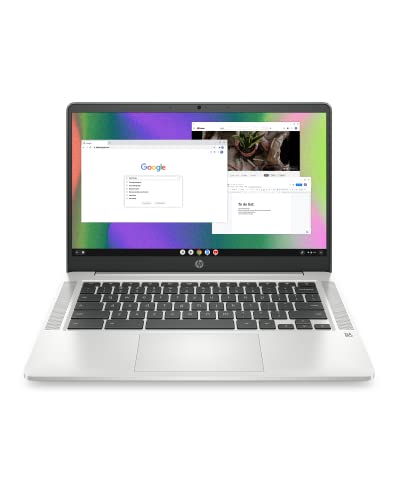
HP’s 14-inch Chromebook makes the most sense for students, light office work, and anyone who wants a simple laptop that starts fast, stays easy to carry, and keeps the price in a practical range. The appeal is straightforward: Chrome OS, a 14-inch anti-glare screen, and a light 3.35-pound chassis create a low-friction daily machine for browsing, documents, video calls, and schoolwork. The trade-off is just as clear, because this is built for basic computing rather than heavy multitasking or demanding creative apps.
I’d put this in the “buy it for school and everyday web work” lane, not the “stretch it into a do-everything laptop” lane. If your routine lives in Chrome, Google apps, Zoom, and a few tabs at a time, it fits well; if you want a more expansive screen, stronger external-display behavior, or a machine that can absorb heavier workloads without compromise, this is not the cleanest choice. The value case is real, but it comes with the usual Chromebook limits and a modest HD panel.
| Screen Size | 14 Inches |
|---|---|
| Resolution | 1366 x 768 pixels |
| RAM | 4GB LPDDR4x-4266 MHz RAM |
| Storage | 64GB eMMC |
| Battery life | Up to 14 hours |
| Wireless | Wi-Fi |
| Ports | USB-A and USB-C; HDMI |
| Webcam | Webcam/camera |
This is a Chrome OS laptop with a Celeron N4120, 4GB of LPDDR4x memory, and 64GB of eMMC storage. It is aimed at simple daily work rather than heavy local software, which is exactly why the price can stay approachable.
For a buyer, that means the best fit is schoolwork, web apps, email, and streaming, with Google and Android app support doing the heavy lifting. The practical limit is storage headroom and raw speed, so a buyer who keeps lots of files locally or expects a desktop-like workload will outgrow it faster.
The 14-inch HD panel uses a 1366 x 768 resolution with anti-glare treatment and a micro-edge design. That combination keeps the laptop easy to place in a backpack and easy to use in bright rooms.
In day-to-day use, the screen is serviceable rather than spacious. It suits browsing, homework, and video calls, but the lower resolution makes fine text work and split-screen multitasking less comfortable than on a sharper display.
Two USB-A ports, one USB-C port, HDMI, and a headphone jack give this Chromebook a practical set of connections for normal school and home use. It also includes a 720p webcam and dual microphones for calls.
That matters because it reduces the need for adapters in common situations, from plugging in peripherals to connecting a monitor. The one buyer caution is simple: this is a basic connectivity setup, so it works best when your needs are ordinary rather than specialized.
Open it on a kitchen table or dorm desk and the first thing that matters is how little friction the setup creates. Chrome OS keeps the start-up path simple, and the confirmed port mix gives you the basics without adapter hunting: two USB-A ports, one USB-C port, HDMI, and a headphone jack. That is enough for a charger, a flash drive, a mouse, and an external display, all on one side of the buying decision that matters most for a student or home-office user. The upside is convenience; the limit is that this is a basic port set, not a workstation-style spread.
For long writing sessions, the 14-inch size and 3.35-pound weight make it easy to move from room to room or tuck into a backpack without turning the laptop into a burden. The 1366 x 768 panel is the bigger comfort question. On a 14-inch display, that resolution keeps the machine in the budget lane, with less room for dense side-by-side work than a sharper panel would offer. Anti-glare helps in bright rooms, and that matters more here than headline styling. This is the kind of screen that works best for documents, browser tabs, and streaming, while buyers who spend hours reading or editing side by side will feel the ceiling quickly.
When the day shifts to video calls and casual media, the practical story is better than the raw spec sheet sounds. The True Vision 720p camera and dual microphones cover the basics for Zoom, and the Wi-Fi 5 and Bluetooth combo keep the machine aligned with normal school and home use. The N4120, 4GB of LPDDR4x memory, and 64GB of eMMC storage define the real boundary: it is comfortable for light multitasking, but not built to keep piling on heavy tabs and apps. That balance is what makes the price attractive, and also what keeps this from being a universal pick.
Community
The pattern is easy to read: buyers keep rewarding this Chromebook for being simple, light, and good value, while the main complaints cluster around the limits you would expect from a basic budget machine. That means the real lesson is not whether it can do everyday work, but whether you are comfortable living within its modest screen, storage, and external-display boundaries.
This is a good basic Chromebook. It is not the fastest machine I have ever used but it gets the work done for a lot less money than others.
No issues at all.
Great weight and size for my 13yo he loves it and perfectly fits in his bookbag! Great quality and price.
Good quality but is NOT compatible with larger screens via HDMI. Connects but does not send through activity. AND does NOT have a backlit keyboard.
| Attribute | HP 14" HD Chromebook Current | HP 14a-na0226nr | Lenovo IdeaPad 1i | HP Chromebook 14a G5 |
|---|---|---|---|---|
| Price | $229.00 | $234.95 | $256.78 | - |
| Screen Size | 14 Inches | 14 Inches | 14 Inches | 14 Inches |
| Resolution | 1366 x 768 pixels | 1366 x 768 pixels | 1366 x 768 pixels | 1366 x 768 pixels |
| RAM | 4GB LPDDR4x-4266 MHz RAM | 4 GB | 12 GB installed | 4 GB DDR4 |
| Storage | 64GB eMMC | 64 GB eMMC | 1.25 TB SSD | 32 GB eMMC |
| Battery life | Up to 14 hours | - | Up to 11 hours | - |
| Wireless | Wi-Fi | - | Wi-Fi | Wi-Fi |
| Editorial score | 66/100 | 64/100 | 69/100 | 60/100 |
Against a more fully loaded 14-inch Windows laptop like the Lenovo IdeaPad 1i, this HP wins on simplicity and likely lower entry cost, but it gives up the roomy 12GB RAM and 1.25TB SSD that make the Lenovo far better for heavier multitasking and storage-heavy work. Choose the HP if your life is mostly browser-based and mobile; choose the Lenovo if you want a broader all-purpose machine with more headroom.
Compared with a typical mainstream clamshell, the HP is the more focused school-and-web route. It is easier to justify if you want Chrome OS, a lighter carry, and a straightforward setup for classes or home use. A mainstream Windows laptop is the better lane if you rely on broader software compatibility, larger local storage, or a more expansive display experience, while this Chromebook stays happiest when the workload stays simple.
Compare with
Add a second model to activate the direct comparison.


No products match that filter combination.
This is a sensible buy for students, families, and home users who want a light, low-friction Chromebook for everyday tasks without paying for more laptop than they need. The combination of Chrome OS, 4GB RAM, 64GB storage, a 14-inch anti-glare screen, and a 3.35-pound body makes the value case easy to understand, especially if the current offer is in the budget range. If you want a sharper screen, more storage, stronger multitasking, or a machine that behaves more like a full-size general-purpose laptop, skip it and move up-market. The clearest reservation is the HD panel and basic Chromebook ceiling, which keep this in the practical school-and-web lane rather than the all-purpose lane.
Yes. It fits browser-based classes, documents, Zoom, and light everyday use very well.
It has HDMI, but the safer expectation is basic everyday use rather than a strong external-display setup.
