
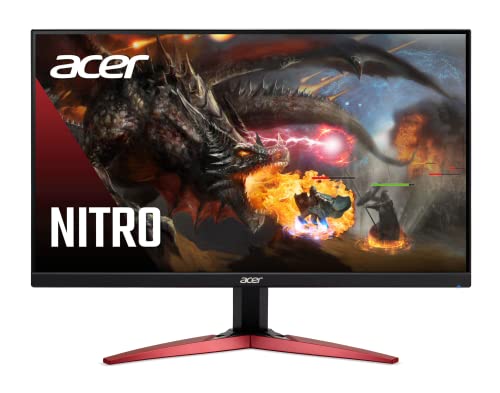
Acer Nitro KG241Y Sbiip
Compact 23.8-inch Full HD layout that fits a normal desk well. The refresh-rate behavior has caused confusion for some buyers who expected a fixed 165Hz path.
Best overall: Acer Nitro KG241Y Sbiip. We compared 14 monitors using current price, editorial assessment, and buyer feedback.
The ranking weighs current price, editorial assessment, useful technical data, and buyer feedback.
Compact 23.8-inch Full HD layout that fits a normal desk well. The refresh-rate behavior has caused confusion for some buyers who expected a fixed 165Hz path.

100Hz refresh rate with Adaptive-Sync adds smoothness for scrolling and casual gaming. The stand does not offer height adjustment.
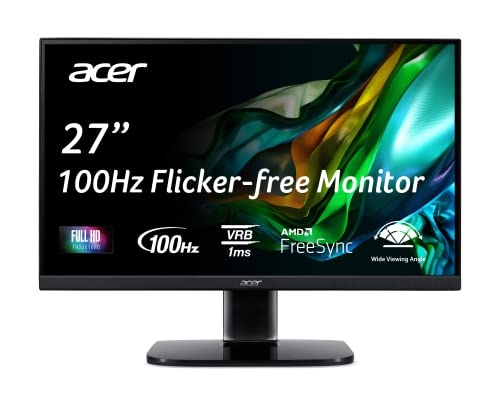
VESA mounting and tilt support make it easy to place on a desk or arm. It is not the best fit for buyers chasing creator-grade detail or a higher-resolution upgrade.
| Acer Nitro KG241Y Sbiip | 23.8 inches | FHD 1080p | 165Hz | 8.6 | 8.6 | $109.99 |
| Philips 221V8LB | 21.5 Inches | FHD 1080p | 100 Hz | 8.8 | 8.0 | $64.99 |
| SANSUI Curved Monitor 27 inch 120Hz USB Type-C | 27 Inches | FHD 1080p | 120 Hz | 8.3 | 8.1 | $115.99 |
| Amazon Basics 27E2UA | 27 Inches | FHD 1080p | 75 Hz | 8.8 | 7.4 | $109.99 |
| Acer KB272 EBI | 27 inches | FHD 1080p | 100Hz (using HDMI port) | 8.8 | 7.7 | $138 |
Acer Nitro KG241Y Sbiip wins on Motion and responsiveness and Panel and image intent; the final gap is 0.4 points over 100.
Philips 221V8LB pushes back on Clarity and workspace and Price value, but it does not offset the overall score gap.
Acer Nitro KG241Y Sbiip stays first because it combines the ranking score, current price, and comparable category signals better than Philips 221V8LB.
Acer Nitro KG241Y Sbiip wins on Ranking score and Price value; the final gap is 5.1 points over 100.
SANSUI Curved Monitor 27 inch 120Hz USB Type-C pushes back on Screen size, but it does not offset the overall score gap.
Acer Nitro KG241Y Sbiip stays first because it combines the ranking score, current price, and comparable category signals better than SANSUI Curved Monitor 27 inch 120Hz USB Type-C.
Acer Nitro KG241Y Sbiip wins on Ranking score and Motion and responsiveness; the final gap is 18.7 points over 100.
Samsung LS34C502GANXZA pushes back on Clarity and workspace and Screen size, but it does not offset the overall score gap.
Acer Nitro KG241Y Sbiip stays first because it combines the ranking score, current price, and comparable category signals better than Samsung LS34C502GANXZA.
Acer Nitro KG241Y Sbiip wins on Ranking score and Motion and responsiveness; the final gap is 6.4 points over 100.
Amazon Basics 27E2UA pushes back on Clarity and workspace and Panel and image intent, but it does not offset the overall score gap.
Acer Nitro KG241Y Sbiip stays first because it combines the ranking score, current price, and comparable category signals better than Amazon Basics 27E2UA.
Acer Nitro KG241Y Sbiip wins on Ranking score and Price value; the final gap is 10.6 points over 100.
Acer KB272 EBI pushes back on Screen size, but it does not offset the overall score gap.
Acer Nitro KG241Y Sbiip stays first because it combines the ranking score, current price, and comparable category signals better than Acer KB272 EBI.
The Acer Nitro KG241Y Sbiip is aimed at buyers who want a compact 23.8-inch gaming monitor that keeps motion smooth without pushing the desk budget or the wallet too hard. Its appeal is straightforward: Full HD resolution, 165Hz refresh, AMD FreeSync Premium, and a VA panel in a ZeroFrame design that fits neatly into a small gaming setup. The trade-off is just as clear, though, because this is built around value and speed rather than extras like speakers or height adjustment.
The Philips 221V8LB is a compact desk monitor for someone who wants a clear 1080p screen, a 100Hz refresh rate, and a simple HDMI or VGA setup without paying for extras they may never use. Its appeal is straightforward: a 21.5-inch viewable VA panel, Adaptive-Sync, and VESA support in a size that fits a work desk, secondary screen setup, or a light gaming corner. The trade-off is equally clear, since this is a no-frills display with limited adjustability and only one HDMI port.
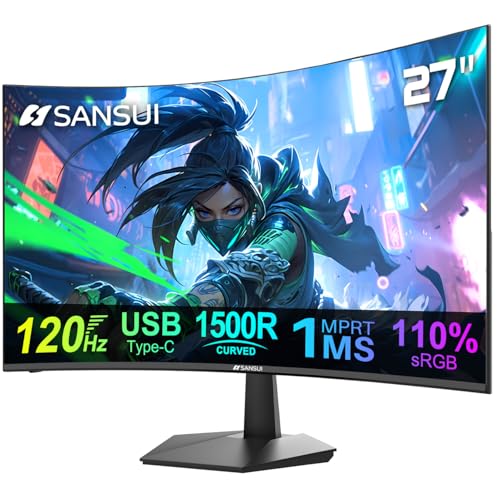
This 27-inch curved SANSUI fits buyers who want a simple desk monitor with a bigger-than-basic canvas, built-in speakers, and a fast-enough 120Hz panel for mixed work and play. The appeal is clear enough: FHD 1080p, 1500R curvature, USB Type-C, HDMI, and VESA support in one package. The main trade-off is just as clear, though, because a 27-inch 1080p screen is about 82 PPI, so text sharpness is not the same story as on a higher-resolution panel.

The Amazon Basics 27E2UA makes the most sense for someone who wants a large, straightforward desk monitor for email, documents, web calls, and streaming without paying for gaming or creator extras. The appeal is easy to see: a 27-inch IPS panel, Full HD resolution, 75 Hz refresh, built-in speakers, and a stand that tilts for a more comfortable angle. The trade-off is just as clear, though. It is built around everyday comfort and value, not around higher-end motion or color-work ambitions.
The Acer KB272 EBI makes the most sense for someone who wants a roomy 27-inch desk monitor that stays simple: Full HD IPS, a 100Hz ceiling over HDMI, AMD FreeSync, and a zero-frame look that works just as well for spreadsheets as it does for casual gaming. The clear trade-off is that this is a comfort-and-pace monitor, not a pixel-dense one, so the 27-inch Full HD layout favors easy reading and broad workspace over razor-sharp text.
The ranking compares published products with a stable framework: editorial quality, buyer signals, current price when the preset requires it, and comparable category metrics. It does not claim original lab testing; it documents how available signals are weighted so the order remains auditable.
Setup: Collect published reviews, current product data, and comparable technical fields.
Measured variable: Coverage for current price, rating, local review URL, and primary category metrics.
Evaluation rule: Only updated products with enough comparable data can enter.
Setup: Cross editorial score, buyer signals, and price when the preset requires it.
Measured variable: Normalized ranking score on a traceable 0-100 scale.
Evaluation rule: The winner must sustain a stronger balance than the finalists, not just one isolated metric.
This ranking is refreshed from published reviews, current category catalog signals, editorial scoring, and current price. Scores are calculated against the eligible category universe; the visible top only shows the models that pass the final cut.
Descending order: the winner has the strongest balance of Q_final and normalized price against the eligible category universe.
Buyer signal uses the scoring v2 Bayesian score; it is not a simple stars times two conversion.
Computed against eligible comparable category candidates, not only against the visible top. P05=94.24; P95=258.04.
If a critical axis falls below the threshold, final quality is penalized so one weak product cannot win only on price.
| Samsung LS24D304GANXZA | 77.2 | Clarity and workspace: 8.7/10. | Ergonomics and ports: 5.8/10. |
| Dell SE2425H | 77.1 | Clarity and workspace: 8.7/10. | Motion and responsiveness: 6.4/10. |
| Samsung LS27D366GANXZA | 74.9 | Clarity and workspace: 8.2/10. | Motion and responsiveness: 6.1/10. |
| Samsung LS34C502GANXZA | 69.1 | Clarity and workspace: 8.2/10. | Motion and responsiveness: 6.1/10. |
| ARZOPA Z1FC | 66.9 | Value by use case: 8.3/10. | Ergonomics and ports: 5.8/10. |
It does not mean choosing the cheapest product by default. The ranking crosses editorial score, buyer satisfaction, useful technical data, and updated price to identify the model with the most defensible balance.
The page prints the latest available refreshed price to make comparison clearer, but Amazon can change price and availability at any time. The live purchase link remains the final check before buying.
Yes. The preset ranking keeps the editorial frame, URL, and components stable while recalculating internal positions when comparable data changes or new models enter the catalogue.
The ranking is not meant to list the whole catalogue. A model first needs a published review, a current price, and comparable signals; then only the set that clears the operational cut is ordered. A product can stay outside the visible top when its price is stale, it has no public URL, its useful data is incomplete, or its balance of quality, user signal, and price remains weaker. This keeps the same freshness gate used across the rest of the site.