Review Routers TP-Link

TP-Link Archer AX21 Router - Review and opinions

TP-Link Archer AX21
81 /100 Overall

Quick recommendation

Value for money 82/100
Ease of use 81/100
Durability 71/100
Customer reviews 88/100

Is it worth it?

The Archer AX21 is a sensible pick for a home network that needs better coverage, cleaner device handling, and a modern Wi-Fi 6 step up without jumping to a pricier class of router. Its appeal is straightforward: dual-band Wi-Fi 6, gigabit Ethernet, mesh expansion support, and the kind of setup path that fits a typical household replacing an ISP gateway or aging Wi-Fi 4 gear. The real trade-off is equally clear, though: it is built for everyday home networking, not for multi-gig wired performance or 6 GHz Wi-Fi.

Buy it if your goal is steadier whole-home Wi-Fi for phones, laptops, consoles, and smart devices, especially when you want to split bands, keep control of the settings, and avoid rental-router frustration. Skip it if you need the fastest possible wired backbone, a tri-band upgrade, or a router that solves a very specific advanced networking job. For the money, it lands in the practical middle ground where ease, coverage, and value matter more than headline speed.

Wi-Fi standard 802.11ax
Wireless speed AX1800, up to 1.8 Gbps total bandwidth
Ports Gigabit Ethernet
Mesh support Easy Mesh
Security Works with Alexa and CISA Secure-by-Design pledge
Frequency band Dual-Band

Key features

Wi-Fi 6 for crowded homes

The AX21 uses 802.11ax dual-band Wi-Fi 6, which is the main reason it belongs in a modern home network conversation. It is built to handle more devices at once with less congestion than older Wi-Fi 5 hardware, and that matters most when the house has streaming, browsing, smart home gear, and gaming happening together.

The practical upside is steadier day-to-day behavior rather than a dramatic speed fantasy. If your current router falls apart when several devices wake up at once, this class of router is the right kind of upgrade.

Coverage tools that matter

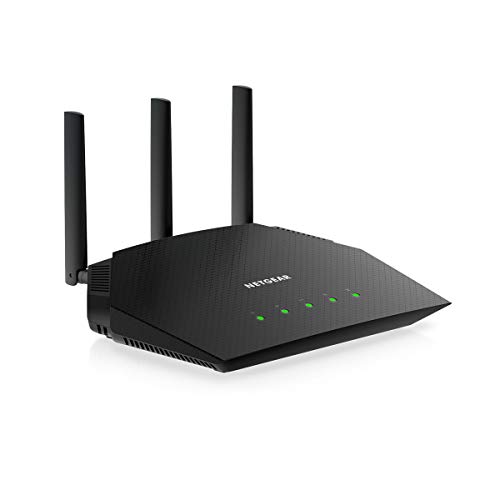
Beamforming, four high-gain antennas, and the front-end module are the features that turn the AX21 from a basic dual-band box into a router that can reach farther into a house. The confirmed theme across the product is coverage that holds up better than older gateway hardware.

That makes it a better fit for larger apartments and typical family homes than for buyers who only care about raw top-end throughput. The limitation is simple: coverage tools help the signal reach farther, but they do not turn the router into a multi-gig performance model.

Wired and mesh-friendly layout

Gigabit Ethernet and Easy Mesh support give the AX21 two very practical routes forward. Wired devices get a proper Ethernet connection, and the router can be paired into a broader mesh-style setup if the house later needs more coverage.

This is useful because it keeps the purchase flexible. You can start with a single router, then extend the network later without replacing the whole setup. The trade-off is that this is still a dual-band home router, so mesh expansion is the growth path, not the core identity.

User experience

For a family home that has phones, tablets, a gaming console, and a few smart plugs all trying to stay online at once, the AX21 fits the kind of daily load that exposes weak routers fast. The Wi-Fi 6 and AX1800 class are enough to make the network feel less crowded, and the four high-gain antennas plus beamforming are the sort of setup that matters when rooms are separated by walls and the router is not sitting right in the center of the house. The payoff is not magic speed; it is fewer small annoyances, like devices hanging onto a weak signal or the network feeling overloaded when several people are active at once.

If you are wiring a desktop, console, or streaming box, the gigabit ports keep the router from becoming the bottleneck on the local side. That matters because the product’s strength is not a fancy port count or multi-gig ambition, but a clean, reliable handoff between the modem, the wired devices, and the rest of the house. In practical terms, this is the kind of router that makes sense when you want stable everyday throughput and you do not need to build a higher-end wired backbone around it.

The setup story is one of the stronger reasons to choose it over a cheaper, more bare-bones router. The included Ethernet cable and quick-install guide fit the usual replace-and-go scenario, and the support line plus Tether app guidance lower the friction for someone moving off an ISP gateway. The trade-off is that the interface is aimed at straightforward home control rather than deep enthusiast tweaking, so it suits a household that wants the network to behave rather than a hobbyist chasing every advanced setting.

Pros

  • Wi-Fi 6 dual-band design suits busy home networks.
  • Gigabit Ethernet keeps wired devices on a clean connection.
  • Easy Mesh support leaves room to expand coverage later.
  • Setup tools and support reduce first-day friction.

Cons

  • Not a fit for buyers who need 6 GHz Wi-Fi.
  • No multi-gig ports for a higher-end wired backbone.
  • Advanced-tuning buyers may find the interface too basic.
  • Best results depend on a normal home layout rather than a demanding, signal-hostile setup.

Community

User reviews

The strongest praise centers on easy setup, stable coverage, and the feeling that the router fixes everyday network friction without making the house more complicated. The main disappointment shows up when someone expects it to solve every edge case, because the AX21 is best at ordinary home networking, not at exotic or overbuilt configurations.

Michelle

As a Spectrum customer, I wanted a router that let me split the 2G and 5G networks so my devices would connect the way I wanted.

Christopher

What an upgrade over WiFi 4. Setup was easy and the administration interface is well designed.

UAstudentn

I wanted a more secure router and I really like the back-office controls TP-Link gives you.

Everyday

Solid coverage and faster speeds than older WiFi 5 units, but the interface is basic if you want deep customization.

Comparison

Attribute TP-Link Archer AX21 Current NETGEAR RAX54S NETGEAR R6700AX-1AZNAS
Price 52.07 USD 55.04 USD 45.16 USD
Ports Gigabit Ethernet 4 x 1 Gig Ethernet ports and 1 USB 3.0 port 4 x 1G Ethernet ports
Wi-Fi standard 802.11ax 802.11ax 802.11ax
Security Works with Alexa and CISA Secure-by-Design pledge security features enabled out of the box with automatic firmware updates and NETGEAR Armor included for 1 year -
Frequency band Dual-Band - Dual-band
Editorial score 81/100 77/100 81/100

Against NETGEAR R6700AX-1AZNAS, the AX21 is the friendlier home-network choice if you want Wi-Fi 6, gigabit ports, and a straightforward dual-band setup without paying for a more aggressive performance tier. The NETGEAR model sits in the same AX1800 neighborhood, so the decision is less about raw class and more about which brand’s software, support style, and home-network feel you prefer. If your priority is simple household coverage and easier setup, the TP-Link is the cleaner pick.

Against NETGEAR RAX54S, the AX21 is the more modest route. The RAX54S steps into a much faster AX5400 class with a stronger performance story and a more ambitious feature set, so it belongs with buyers who care about higher-end throughput and broader headroom. The AX21 makes more sense when the house needs dependable Wi-Fi 6, gigabit wired connections, and a better value position than a premium speed-first router.

Conclusion and verdict

The Archer AX21 is easy to recommend for buyers who want a practical Wi-Fi 6 upgrade that improves everyday home networking without turning the purchase into a project. It brings together dual-band Wi-Fi 6, gigabit Ethernet, Easy Mesh support, and a setup path that makes sense for replacing an ISP router or aging home gear. If the current offer is in the usual budget-friendly range, it is one of the more convincing value picks in this class. If you need 6 GHz, multi-gig ports, or a router built around advanced performance headroom, this is not the right stop. Its strengths are steadier coverage, simple control, and a better day-to-day experience for ordinary homes. That makes it a strong buy for the right household and an easy skip for anyone shopping upmarket.

Still, compare TP-Link Archer AX21 with close alternatives if warranty, noise, real battery life, or included accessories are decisive for you.

FAQ

Is this a good router for a normal family home?

Yes. It fits the common mix of phones, laptops, consoles, and smart devices, especially when you want better coverage and less congestion than an older gateway.

Does it replace a modem?

No. It is a router, and a separate modem is still required for most internet service setups.

Jake Miller

About the author

Jake Miller

As a passionate tech enthusiast, I review the latest PCs, laptops, and hardware components. With detailed tests and honest insights, I aim to help users build or buy the perfect setup for their needs.