
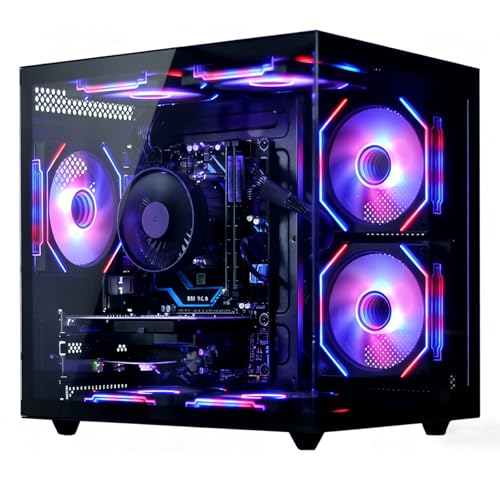
suevery SUT1B1-SUT1B9 Gaming PC
512 GB SSD and Wi-Fi 6 make setup and daily use less awkward. One reported boot-device issue and one report of a broken fan show that early setup and build consistency are not the strongest part of the story.
Best overall: suevery SUT1B1-SUT1B9 Gaming PC. We compared 7 desktops using current price, editorial assessment, and buyer feedback.
The ranking weighs current price, editorial assessment, useful technical data, and buyer feedback.
512 GB SSD and Wi-Fi 6 make setup and daily use less awkward. One reported boot-device issue and one report of a broken fan show that early setup and build consistency are not the strongest part of the story.

Quiet, polished tower design with AlienFX lighting and a clear side panel The gaming-first size and styling are less appealing if you want a plain office desktop.

Tower chassis, air cooling, and 750W power supply support long-term use and expansion. USB-C is data only, so single-cable display setups are not the easy path.
Read review| suevery SUT1B1-SUT1B9 Gaming PC | 16 GB DDR4 | Ryzen 5 6-Core 3.6 GHz up to 4.1 GHz | 8.3 | 8.0 | $599.99 |
| Lenovo ThinkStation P3 Tower Gen 2 | 256GB DDR5-6400MHz RAM [CUDIMM] (64GB x 4) | Intel Core Ultra 9 285 Processor with vPro, up to 5.40 GHz turbo | 8.3 | 8.8 | $7,499 |
| Lenovo Legion Tower 5i | 16 GB DDR5 5600MHz, expandable to 128 GB | Intel Core Ultra 7 265F | 8.3 | 8.8 | $1,799.99 |
| Alienware Aurora Gaming Desktop ACT1250 | 16GB Dual Channel DDR5 (2x 8GB) 5200 MT/s Memory | Intel Core Ultra 7 265F | 8.3 | 8.4 | $1,699.99 |
| Alienware Aurora ACT1250 | 32 GB DDR5 | Intel Core Ultra 7 265F | 8.3 | 8.8 | $1,999.99 |
suevery SUT1B1-SUT1B9 Gaming PC wins on Ranking score and Price value; the final gap is 15.2 points over 100.
Lenovo ThinkStation P3 Tower Gen 2 pushes back on Configuration balance and Sustained performance, but it does not offset the overall score gap.
suevery SUT1B1-SUT1B9 Gaming PC stays first because it combines the ranking score, current price, and comparable category signals better than Lenovo ThinkStation P3 Tower Gen 2.
suevery SUT1B1-SUT1B9 Gaming PC wins on Ranking score and Price value; the final gap is 16.5 points over 100.
Lenovo Legion Tower 5i pushes back on Configuration balance and Sustained performance, but it does not offset the overall score gap.
suevery SUT1B1-SUT1B9 Gaming PC stays first because it combines the ranking score, current price, and comparable category signals better than Lenovo Legion Tower 5i.
suevery SUT1B1-SUT1B9 Gaming PC wins on Ranking score and Price value; the final gap is 18.2 points over 100.
Alienware Aurora Gaming Desktop ACT1250 pushes back on Chassis and airflow and Sustained performance, but it does not offset the overall score gap.
suevery SUT1B1-SUT1B9 Gaming PC stays first because it combines the ranking score, current price, and comparable category signals better than Alienware Aurora Gaming Desktop ACT1250.
suevery SUT1B1-SUT1B9 Gaming PC wins on Ranking score and Price value; the final gap is 21.0 points over 100.
Alienware Aurora ACT1250 pushes back on Chassis and airflow and Configuration balance, but it does not offset the overall score gap.
suevery SUT1B1-SUT1B9 Gaming PC stays first because it combines the ranking score, current price, and comparable category signals better than Alienware Aurora ACT1250.
If you want a budget gaming tower that can also handle everyday home-office work, this Suevery build is aimed at that middle lane: a Ryzen 5 six-core processor, 16 GB of RAM, a 512 GB SSD, and a dedicated RX 560 4 GB card give it a real desktop foundation instead of a bare-bones starter box. The trade-off is just as clear, though, because the RX 560 class keeps it in entry-level gaming territory rather than the kind of machine that makes every demanding title disappear into max settings.
If you need a tower that can carry serious creative or engineering work without pretending to be a gaming box, the ThinkStation P3 Tower Gen 2 lands in a very specific lane. The combination of Intel Core Ultra 9 285 vPro, RTX 4000 Ada graphics, 256GB of DDR5-6400 memory, and a 2TB PCIe Gen 5 SSD makes it relevant for buyers who care more about sustained workstation headroom than compactness or bargain pricing. The trade-off is that this is a desk-bound machine with a premium parts mix, so it makes the most sense when the workload justifies the spend.

If you want a gaming tower that is ready for Windows 11 Home, carries a dedicated RTX 5060 Ti, and still leaves room to grow later, the Legion Tower 5i lands in a useful middle lane. It fits best for a desk-bound gamer or creator who values a clean, expandable setup over a tiny footprint, but the trade-off is that 16 GB of memory and 1 TB of storage are only the starting point for a machine built around heavier play.
If you want a gaming tower that arrives with a clear performance-first identity, the Alienware Aurora ACT1250 is built for that lane: Intel Core Ultra 7 265F, RTX 5060 Ti, 16GB of DDR5, and a 1TB SSD in a 500W Platinum-rated, air-cooled chassis. That combination makes it relevant for players who want a ready-to-run desktop for modern games and everyday multitasking, but the trade-off is just as clear: this is not the kind of machine you buy for broad upgrade headroom or a roomy, overbuilt power path.
If you want a gaming tower that feels ready for serious play and creative work without jumping into a full custom build, the Alienware Aurora ACT1250 lands in a very specific lane. The appeal is the combination of an Intel Core Ultra 7 265F, 32GB of DDR5 memory, a 1TB SSD, and an RTX 5070, which gives it the kind of headroom that matters for modern games, livestreaming, and multitasking. The trade-off is just as clear: this is a premium-priced desktop, and the value only makes sense if you actually want a dedicated gaming rig with a strong GPU and a polished chassis, not a plain office tower.
The ranking compares published products with a stable framework: editorial quality, buyer signals, current price when the preset requires it, and comparable category metrics. It does not claim original lab testing; it documents how available signals are weighted so the order remains auditable.
Setup: Collect published reviews, current product data, and comparable technical fields.
Measured variable: Coverage for current price, rating, local review URL, and primary category metrics.
Evaluation rule: Only updated products with enough comparable data can enter.
Setup: Cross editorial score, buyer signals, and price when the preset requires it.
Measured variable: Normalized ranking score on a traceable 0-100 scale.
Evaluation rule: The winner must sustain a stronger balance than the finalists, not just one isolated metric.
This ranking is refreshed from published reviews, current category catalog signals, editorial scoring, and current price. Scores are calculated against the eligible category universe; the visible top only shows the models that pass the final cut.
Descending order: the winner has the strongest balance of Q_final and normalized price against the eligible category universe.
Buyer signal uses the scoring v2 Bayesian score; it is not a simple stars times two conversion.
Computed against eligible comparable category candidates, not only against the visible top. P05=929.99; P95=6059.297.
If a critical axis falls below the threshold, final quality is penalized so one weak product cannot win only on price.
| MSI Codex Z2 A8NVP-436US | 60.7 | Sustained performance: 9.8/10. | Expandability: 5.8/10. |
| ASUS ROG G700 | 56.5 | Sustained performance: 9.8/10. | Noise and refinement: 7.5/10. |
It does not mean choosing the cheapest product by default. The ranking crosses editorial score, buyer satisfaction, useful technical data, and updated price to identify the model with the most defensible balance.
The page prints the latest available refreshed price to make comparison clearer, but Amazon can change price and availability at any time. The live purchase link remains the final check before buying.
Yes. The preset ranking keeps the editorial frame, URL, and components stable while recalculating internal positions when comparable data changes or new models enter the catalogue.
The ranking is not meant to list the whole catalogue. A model first needs a published review, a current price, and comparable signals; then only the set that clears the operational cut is ordered. A product can stay outside the visible top when its price is stale, it has no public URL, its useful data is incomplete, or its balance of quality, user signal, and price remains weaker. This keeps the same freshness gate used across the rest of the site.